Mag 5, 2012 | Arte e cultura, Lucca
 Si dice che sul Ponte della Maddalena, che collega le due sponde del Serchio vicino al paese di Borgo a Mozzano, nel 1300 lo stesso costruttore del ponte strinse un patto con il maligno: sarebbe riuscito a finire l’opera nei tempi prestabiliti a patto di consegnare a Satana l’anima del primo malcapitato che avesse attraversato il fiume.
Fu così che, su suggerimento del prete del paese, il primo a passare il ponte fu un maiale e il demonio scomparve, roso dalla rabbia per l’inganno.
Da questa leggenda prende il nome uno dei ponti più belli ed affascinanti della Toscana, il Ponte del Diavolo, uno dei tanti misteriosi simboli della Garfagnana.
Questa terra incastonata tra le Alpi Apaune e l’Appenino Tosco Emiliano, è da sempre considerata magica, per le numerose favole e i luoghi incantati che la popolano.
Tra le perle da visitare sul territorio c’è la Grotta del Vento, un’incredibile complesso sotterraneo dove è possibile ammirare surreali paesaggi disegnati dalla stratificazione secolare del terreno.
Risalendo invece la gola calcarea dell’Orrido di Botri, canyon formato dallo scorrere di due torrenti, s’incontrano incredibili piscine naturali immerse nel silenzio della natura e, se si raggiungono i 200 m, chissà che non s’incontri pure un’aquila reale.
Fortunato è stato chi è riuscito a scorgere il campanile o addirittura passeggiare tra i vicoli di Vagli, il villaggio sommerso, custodito nella diga artificiale omonima e che solo saltuariamente, per i lavori di manutenzione del bacino, riemerge alla luce del sole.
In un immaginario itinerario lungo la Garfagnana, impossibile non fermarsi a Barga, riconosciuto dal Touring Club come uno dei borghi più belli d’Italia, ultimo rifugio del Poeta Giovanni Pascoli, che a Barga dedicò alcuni dei suoi versi più belli e la cui casa ancora oggi è aperta ai visitatori.
www.ingarfagnana.orgIt is said that the bridge builder made a pact with the devil in 1300 on the Ponte della Maddalena, which connects the two generic viagra online banks of the Serchio, close to the town of Borgo a Mozzano: he would be able to finish the work before the deadline as long as the soul of the first wretch to cross the river would be given to Satan.
That’s why, upon the suggestion of the town’s priest, the first to cross the bridge was a pig and the demon appeared, red with rage for the trick. One of the most beautiful and striking bridges in Tuscany, Ponte del Diavolo takes its name from this legend, one of the many mysterious symbols in the Garfagnana.
This land wedged in between the Apuan Alps and the Tuscan-Emilian Apennines has always been considered magical for the many tales and enchanting places that are found there.
Among the gems to be visited in the area, there’s the Grotta del Vento, an incredible underground complex where you can take in the surreal landscape designed by the centuries-old stratification of the ground.
Climbing up the chalky gorge of Orrido di Botri instead, a canyon formed by the flowing of two torrents, you come across incredible natural swimming pools immersed in the silence of nature, and who knows if you’d even come across a real eagle if you continue above 200 metres.
You’re one of the lucky one if you’re able to catch a glimpse of the bell tower or walk around the alleyways of Vagli, the sunken village, preserved in the man-made dam of the same name and which only re-emerges in the light of the sun occasionally for basin maintenance works.
Along an imaginary route along the Garfagnana, stopping in Barga is almost mandatory, acknowledged by Touring Club as one of the loveliest towns in Italy, the last refuge of the poet Giovanni Pascoli, to which he dedicated some of his best verse and whose house is still open to visitors today.
BOX: www.ingarfagnana.org
Mag 5, 2012 | Arte e cultura, Lucca
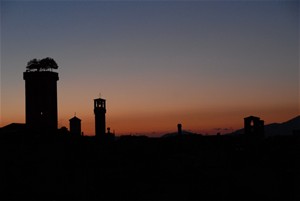 di Giuseppe Raimondi – Come ha detto Guido Piovene, Lucca è “una città esemplare il cui disegno storico si conserva quasi intatto ed è compreso in un solo sguardo”.
Un disegno storico che supera l’evidenza urbanistica e architettonica e che ha lasciato tracce nel costume e nel temperamento dei suoi cittadini: la moderazione, la tolleranza, il dialogo, un’innata predisposizione per gli accordi che rende Lucca così diversa dalle altre città toscane.
Quelle mura, che hanno difeso militarmente e politicamente la città, l’hanno anche tenuta al riparo da contaminazioni indesiderate e da invasioni culturali preservando il senso forte della “libertas” – valore fondante della società liberale.
Lucca è da sempre “autonoma”, addirittura dal 180 a.C. quando era colonia latina con uno statuto di “Municipium” – che le dava una discreta autonomia amministrativa.
Capitale longobarda e, in seguito, polo strategico sotto Carlo Magno, alla fine del X secolo Lucca era la capitale del vasto Marchesato di Toscana.
Con poche interruzioni, Lucca è rimasta libera – come Comune, Repubblica e Ducato – fino al 1847 quando si è inserita in modo vitale nello Stato unitario.
Una piccola Svizzera che ha saputo evitare i conflitti. E non era facile dato che la Lucchesia è da sempre terra di transito obbligato per il Centro e il Sud d’’Italia.
Lucca ha saputo difendere la sua indipendenza con un’abile capacità negoziale, basata sulla moneta e sulla diplomazia.
Da una parte, infatti, Lucca pagava in moneta contante sia gli alleati, sia i potenziali nemici, dall’altra, la città svolgeva una continua attività diplomatica per mantenere l’equilibrio con le potenze da cui dipendeva la sua autonomia.
Un’indipendenza che oggi potremmo definire “a sovranità limitata” fatta soprattutto in funzione antimedicea ed antifiorentina.
Il fatto di non aver subìto una Signoria di lunga durata ha permesso a Lucca di sviluppare un forte senso civico e istituzioni che consentivano una maggiore partecipazione. Insomma, è stata la culla di un vero e proprio federalismo “ante litteram”.
Il costo delle alleanze e la crescita dei contatti negoziali si sono trasformati in un formidabile incentivo allo sviluppo dei commerci e delle ricchezze.
Per questa singolare evoluzione storica, Lucca è oggi un modello di cultura e di filosofia di vita. E’ una delle città più belle della Toscana proprio per il senso della misura e dell’armonia che si respira in ogni angolo della città. Non c’’è un monumento che prevarichi gli altri. La città si sviluppa in modo armonico, fra piazze e vicoli, circondata dalle grandi Mura, che sono cornice ed emblema di questa misura e di quest’armonia. di Giuseppe Raimondi – As Guido Piovene said, Lucca is “an exemplary town Viagra whose historic layout is practically still intact and is understood in a single glance”.
A historic layout that overcomes the evidence of its architecture and town planning and that left traces in the make-up and temperament of its townsfolk: their moderation, tolerance, dialogue and an innate predisposition for agreements which makes Lucca so different from other Tuscan towns.
Those walls, which have defended the town from a military and political point of view, have also sheltered it from unwanted contamination and cultural invasions, preserving the strong sense of libertas, the founding value of liberal society.
Lucca has always been “autonomous,” actually since 180 B.C. when it was a Latin colony with a Municipium statute, which gave it a discrete administrative autonomy.
Longobard capital and, later on, a strategic centre under Charlemagne, at the end of the 10th century, Lucca was the capital of the vast March of Tuscany.
Apart from a few interruptions, Lucca remained free – as a municipality, republic and duchy – until 1847 when it was a vital component included in the unified state.
A small Switzerland that has always known how to avoid conflict; and it wasn’t easy as the Lucchesia has forever been a land of obligatory passage for Central and Southern Italy.
Lucca knew how to defend its independence with clever negotiating skills, based on currency and diplomacy.
On one hand, Lucca in fact paid its allies and potential enemies in money; on the other hand, the town did continuous diplomatic work to maintain equilibrium with the powers on which its autonomy depended.
This is an independence that we could now call “limited sovereignty” practised above all against the Medici family and Florence.
The fact that Lucca was not subjected to a long Signoria allowed it to develop a strong sense of civic pride and institutions that enabled greater involvement. In short, it was the cradle of a real federalism that was ahead of its time.
The cost of the alliances and the growth in negotiating contacts were transformed into a formidable incentive for the development of trade and riches.
For this historic development alone, Lucca is now a model of culture and a way of living. It is one of the most beautiful towns in Tuscany for its sense of measure and harmony, which you can feel in every corner of the town. No one monument outshines the others. The city extends in a harmonious way, amongst squares and alleyways, surrounded by the great walls, which are the frame and symbol of this measure and harmony.
