Set 3, 2012 | Argentario, Arte e cultura
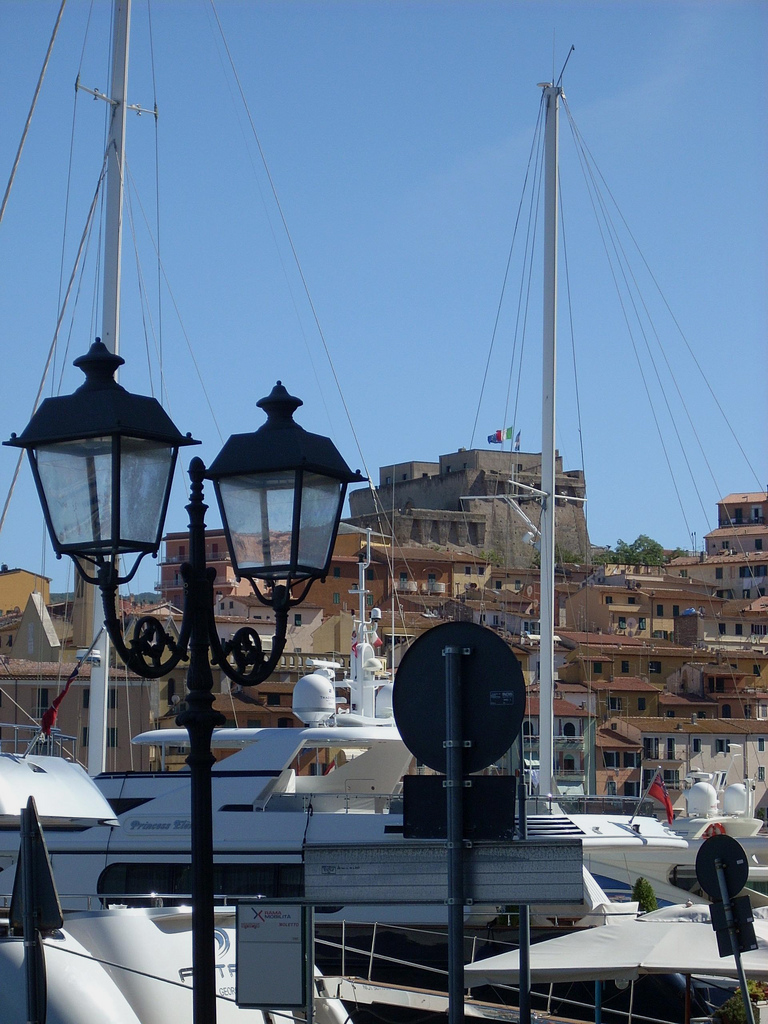 Porto Santo Stefano, definito da molti “la perla dell’Argentario”, si estende su due insenature, Valle e Pilarella, divise da uno sperone chiamaro Croce.
Ville e palazzi risalgono dal mare verso la Panoramica, dove si sviluppa l’ultimo rione, detto la Fortezza per la presenza dell’antico cassero medioevale prima senese e poi spagnolo, ottimamente restaurato e visitabile.
Il pendio è un anfiteatro di case, vigne ed oliveti, ed è rivolto verso il golfo di Punta Madonella.
Il centro abitato inizia con il Porto del Valle, seguito da quello della Pilarella, che in epoca romana costituiva lo scalo da cui salpavano le navi dirette alle ville patrizie del Giglio. Adesso il nuovo Porto del Valle offre buon riparo dai venti di mare che solitamente si abbattono sui porti della costa tirrenica, primo fra tutti il Libeccio, il più irruento e temibile.
D’estate il porto si arricchisce di numerose imbarcazioni di vacanzieri, che si aggiungono alla flottiglia di peschereggi, tra le prime del Tirreno.
Il resto del paese si sviluppò ai primi del Seicento; la costruzione della Fortezza determinò l’immigrazione di pescatori dal meridione e dall’Elba, e l’abitato si estese verso la Punta Madonnella prendendo il nome del patrono. Il Valle è collegato da due strade con il Piazzale dei Rioni, davanti al quale si trova la tranquilla fascia di mare della Pilarella, dove a Ferragosto si svolge il tradizionale palio marinaro, al quale prendono parte tutti e quattro i rioni: Pilarella, Valle, Croce e Fortezza.
La prima delle due strade è il Lungomare dei Navigatori, che segue il perimetro esterno del rione Croce e raggiunge la Pilarella. L’altra via è Corso Umberto, che attraversa poco più a monte lo stesso rione, e che brulica di negozi e ristorantini pittoreschi.
Il Valle si presenta come la zona commerciale ed artigianale, mentre nelle altre contrade si sviluppano maggiormente le attività turistiche.
La strada Panoramica si allontana verso l’alto tra le numerose ville e la Fortezza, costruita nel ‘600, di forma quadrata, con ponte levatoio e muraglia con rinforzi a scarpa in puro stile aragonese e somigliante più ad una torre che ad una vera fortezza. Numerose sono le torri spagnole di avvistamento che circondano la penisola argentarina, silenziose testimoni di una passato militare ed oggi sentinelle delle splendide cale e delle cristalline acque sottostanti.
Alcune di esse sono divenute residenze private, altre, per la loro posizione isolata e scomoda, rimangono disabitate.
Da ricordare la Torre Argentiera, la più antica, che si dice abbia dato il nome all’Argentario stesso: un tempo antica fonderia senese per l’argento, che si narra fosse presente nel promontorio.
Infine immancabile una statua raffigurante il Patrono della cittadina, Santo Stefano, realizzata in terracotta dallo scultore contemporaneo Emilio Greco, situata presso l’altare della chiesa del rione Croce.
Passegiando per Porto Santo Stefano sarete colti dagli odori, i sapori e i colori particolarmente intensi, incantati dalle tante orchidee selvatiche e dalla dorata ginestra.
Porto Santo Stefano, defined by many as “the pearl of the Argentario”, lies on two inlets, Valle and Pilarella, divided by a spur called Croce.
Villas and palaces rise from the sea towards la HGH Panoramica, where the last area of the town rises, called la Fortezza due to the presence of the old medieval fortress which first belonged to Siena and then to Spain.
It has been finely restored and can be visited. The sloping hill is an amphitheatre of houses, vineyards and olive groves, and is turned towards the gulf of Punta Madonella. The town centre starts at Porto del Valle, followed by that of Porto della Pilarella, which in Roman times was the harbour from which ships set sail for the patrician villas of the Isle of Giglio.
Now the new Porto del Valle offers good shelter from the sea winds that usually hit the ports of the Tyrrhenian coast, especially the Libeccio, the most violent and terrible of all. In summer the port is used by numerous holiday boats, which are added to the fleet of fishing boats, one of the largest in the Tyrrhenian Sea.
The rest of the town developed at the beginning of the seventeenth century; the construction of the fortress caused fishermen to come here from the South and from Elba, and the residential area grew towards Punta Madonnella taking the name of the patron saint.
Two roads link the Valle with Piazzale dei Rioni, in front of which lies the calm stretch of sea called the Pilarella, where the traditional sea Palio is held on the 15th August, in which all four quarters take part: Pilarella, Valle, Croce and Fortezza.
The first of the two roads is called Lungomare dei Navigatori and runs along the borders of the Croce quarter to reach Pilarella.
The other road is Corso Umberto which crosses the same quarter a little higher up and is teaming with shops and picturesque restaurants. Valle is the commercial and craft area, while mainly tourist activities are carried out in the other quarters.
The panoramic road goes up into the hills towards the numerous villas and the square Fortress, built in the seventeenth century featuring a drawbridge and walls with escarpments in pure Aragonese style, looking more like a tower than a real and proper fortress.
There are numerous Spanish look-out towers surrounding the peninsula of Argentario, silent witnesses of a military past and today guardians of the splendid coves and the crystal clear water of the sea.
Some of these have become private residences, others, given their isolated and difficult position, are uninhabited. We should mention the Torre Argentiera, the oldest tower that is thought to have given the name Argentario to the peninsula itself: once it was an old Sienese foundry for smelting silver that is thought to have been present on the promontory. Lastly, there is the ever-present statue of the patron Saint of the town, St Stephen, made from terracotta by the contemporary sculptor, Emilio Greco, situated on the altar of the church in the Croce quarter. If you go walking in Porto Santo Stefano you’ll be amazed by the particularly intense fragrances, flavours and colours, and enchanted by the numerous wild orchids and golden juniper trees.
Mag 5, 2012 | Arcipelago | Costa degli Etruschi, Da non perdere
 di Nadia Fondelli – Alessandro Bossini, trentenne gigliese, occhi azzurri come le spiagge della sua isola e ricciolo ribelle è veramente un personaggio fuori da ogni canone quando cerca di convincerti che le sue non sono imprese straordinarie, ma “cosette” quasi normali come se lui non fosse un pluricampione di Triathlon e un uomo dai record estremi!
Ha voluto solo dice “scoprire il mondo e se stesso viaggiando in solitario ed incontrando tanta umanità”. Non un divo strombazzato, ma una persona spontanea che cerca solo di far capire che le barriere, le distanze e le difficoltà sono un grande arricchimento.
Ha iniziato così, quasi per caso, un giorno, inforcando la sua bicicletta a Firenze e ritrovandosi poi, pedalata dopo pedalata a Valencia!
Da lì non ha più smesso e dal 2005 viaggia per il mondo in bici in solitaria. Periplo dell’India e del Nepal, il Giro del Mediterraneo, periplo dell’Australia e giro dell’Italia i suoi viaggi in cui si è impegnato a promuovere valori sociali al tal punto che, la regione Toscana, la provincia di Grosseto e il comune di Isola del Giglio l’hanno battezzato “ambasciatore di pace”.
Alessandro Bossini in silenzio, senza la gran cassa a far risuonare la sua musica ha continuato poi a portare avanti questi valori anche in acqua ricordandosi di essere uomo di mare ed ha così frantumato tutti i record anche in questo settore compiendo imprese ineguagliate di traversate a nuoto in solitaria nei seguenti tratti: Isola di Giannutri – Isola del Giglio, Isola d’Elba – Isola del Giglio, Isola di Montecristo – Isola del Giglio e poi, recentemente la Prima Traversata dell’Arcipelago Toscano a nuoto in cui ha coniuugato le finalità della promozione del territorio, dello sport e dell’impegno sociale.
65 ore di nuotata in cui Alessandro non potrà aver alcun contatto con le barche di supporto pena l’invalidazione del record alla cui regolarità è preposta la FIN.
Ma perché lo fa?
Perché amo il mare ed è normale per un ragazzo che come me, nato su un’isola, provare a sfidare il blu. Cominci fin da ragazzino con gli amici sfidandogli a raggiungere, giorno dopo giorno, lo scoglio più lontano e fu così che un giorno sono arrivato a Giannutri…
Cosa si prova in queste lunghe nuotate in solitario?
Gioia, senso di libertà e contatto vero con i rumori e gli odori della natura incontaminata delle nostre isole che voglio mettere in risalto. 7 isole fra le più belle del Mediterraneo, 7 perle di cultura e di storia ancora poco valorizzate nella loro unicità.
Si fa promotore dell’Arcipelago dunque?
Sì, voglio porre l’accento sul calore speciale delle genti isolane, sulle loro tipicità gastronomiche e sugli scenari selvaggi del mare. 7 isole così vicine, ma così diverse e lontane.
Vorrei che questo mare che divide le isole, simbolicamente con la mia traversata non fosse più un ostacolo, ma un ponte sfatando il mito degli isolani “reclusi del blu” e confinati dalle onde. Il mare non è una prigione, ma una via d’incontro, basta leggersi la storia.
Sappiamo che ci tiene a valorizzare anche le acque costiere e le sue biodiversità?
Bisogna migliorare la gestione e conservare le biodiversità terrestri e marine delle nostre isole. Il mio nuotare senza ausilio di mezzi meccanici significa proprio rivalutare la dimensione umana e porsi di fronte alla natura non come tiranno, ma come fruitore rispettoso del suo equilibrio.
Poi c’è da promuovere il nuoto di fondo?
Sì perché è questa una disciplina che ha scarso appeal mediatico eppure la bellezza e la libertà che si riesce ad esprimere in questa attività raramente si ritrovano altrove.
Questa Traversata strizza l’occhio a tutti gli amanti del mare. Un invito a non temere l’azzurro perché, se rispettato, offre molto: la libertà di un’onda, il sorriso dei delfini, il colore dei tramonti e molto altro ancora…
Infine e non ultimo per importanza il suo impegno forte e deciso nel sociale…
L’impresa che mi prefiggo ha una valenza sociale oltrechè sportiva. Tentare di abbattere una barriera così vasta e apparentemente incolmabile per le forze dell’ uomo, vuole essere di esempio a tutti per superare tutte quelle incertezze che ci immobilizzano nelle nostre paure.
Sono al fianco degli splendidi ragazzi del Gruppo Elba perché vivere insieme a loro dona gioia. Vorrei che nella “Run x you” di fine giugno abbiano voglia di abbattere anche loro alcune barriere buttandosi in mare con me, anche solo per pochi metri, anche solo per provare il brivido di un istante nell’azzurro. Vorrei che tutti possano abbattere le barriere delle diversità e delle difficoltà quotidiane.di Nadia Fondelli – Alessandro Bossini, the Giglio-born 30-year-old with eyes as blue as the waters of his island live sex video chat and curly-haired rebel, is truly an out-of-the-ordinary character when he tries to convince you that his are not extraordinary ventures, but almost normal little things as if he weren’t a many times triathlon champion and a man with extreme records!
He just wanted to say, “discovering the world and oneself travelling alone and meeting lots of humanity.” He isn’t a boastful diva, but a spontaneous person who just tries to get the message across that barriers, distances and difficulties are a real embellishment.
He began one day as if by accident by getting on his bike in Florence and ending up, pedal after pedal in Valencia!
From then on he’s never stopped and he’s been cycling alone around the world since 2005. Cycling around India and Nepal, the Mediterranean, Australia and Italy, his travels whereby he has undertaken to promote social values to such a point that the Tuscan regional government, Grosseto provincial government and the Giglio Island council have conferred upon him the title of “ambassador of peace”.
Alessandro Bossini in silence, without the loud speaker to blast out his music, he has also continued to promote these values in the water, having remembered that he’s a man of the sea, also smashing all the records in this field, fulfilling unparalleled undertakings of lone swimming crossing in the following stretches: Giannutri island – Giglio island, Elba island – Giglio island, Montecristo island – Giglio island and the recently First Tuscan Archipelago Swim Crossing, which will bring together the aims of promoting the area, sport and social commitment.
65 hours of swimming when Alessandro cannot have any contact with the support boats, else the record will be rendered invalid according to FIN, which is in charge of the regulations.
Why are you doing it?
Because I love the sea and it’s normal for a lad who, like me, born on an island, wants to take on the waves. I started when I was a boy with my mates, challenging one another to reach, day after day, the furthest rock and so one day I reached Giannutri…
What goes through your mind during these long lone swims?
Joy, a sense of freedom and real contact with the sounds and smells of the unpolluted nature of our islands, which I want to bring into the spotlight. Seven of the most beautiful islands in the Mediterranean, seven pearls of culture and history still underdeveloped in their uniqueness.
Are you promoting the archipelago then?
Yes, I’d like to emphasise the special warmth of the islanders, their typical cuisine and the wild scenery of the sea. Seven islands so near and yet so different and distant. With my crossing, symbolically, I’d like this sea, which divides the islands, to no longer be seen as an obstacle, but a bridge exploding the myth of the islanders as hermits of the sea and confided by the waves. The sea is not a prison, but a meeting point; just read the history books.
We also know that you care about promoting the coastal waters and their biodiversity.
We need to improve the management and preserve the land and marine biodiversities of our islands. My swim, without the help of mechanical means, means reassessing the human dimension and offering ourselves to nature not as a tyrant but as a respectful user of its equilibrium.
Are you also promoting open sea swimming?
Yes, because this is a discipline that has little media appeal despite the beauty and freedom that this activity offers, which is rarely found elsewhere. This crossing attracts all sea lovers; an invitation to not fear the sea since, if respected, it offers so much: the freedom of the waves, the smile of dolphins, the colours of the sunset and much more…
Last but not least, what do you have to say about your strong and decisive commitment to society?
The enterprise that I’ve set for myself has a social and sporting value. Attempting to break down such a vast and seemingly overwhelming barrier for man’s strengths means being an example for everyone to overcome all the uncertainties that paralyse us with fear.
I’m right by the side of the wonderful youth of Gruppo Elba because being with them gives me joy. I’d also like some of them to break down their own barriers at Run x you at the end of June by diving into the sea with me, if only just for a few metres, just to feel the excitement of a moment in the sea. I’d like everyone to be able to break down the barriers of diversity and everyday problems.
Apr 12, 2012 | Arte e cultura, Eventi, Firenze
 In Toscana il fiore è chiamato giaggiolo (dal latino gladius = spada) per la struttura spatiforme delle foglie.
L’iris è da sempre il simbolo di Firenze: una rappresentazione stilizzata del fiore appare nei soldi d’argento della repubblica fiorentina del XII secolo e, successivamente, nel fiorino d’oro.
Il “giglio” che appare nel gonfalone fin dal 1250, è in realtà un’iris bianca della varietà alba florentina – che cresceva spontaneamente nella valle dell’Arno.
Nel 1266, dopo la cacciata dei Ghibellini, i Guelfi invertirono i colori dello stemma cittadino, creando l’insegna che è rimasta fino ad oggi: un’iris rossa – mai esistita in natura – su sfondo bianco.
Per confermare il ruolo di Firenze come “Capitale dell’Iris”, esiste, dal 1954, un Concorso Internazionale che premia le migliori varietà di iris e ne conserva una traccia storica nell’apposito Giardino del Podere dei Bastioni, sul lato est del Piazzale Michelangelo.
Ogni anno il Concorso richiama gli ibridatori di tutto il mondo, che propongono varietà nuove nei colori e nelle forme.
Una giuria internazionale conferisce, alla varietà più bella, il “Fiorino d’oro”; inoltre, il Comune assegna il premio “Città di Firenze” al fiore il cui colore si avvicina maggiormente al rosso del gonfalone.
E’ rimasta storica la vittoria, nel 1973, dell’americano George Specht con “Rosso Fiorentino” la prima Iris ibridata in Italia ad aggiudicarsi entrambi i premi.In Tuscan, the flower is called “giaggiolo” (from the Latin gladius = sword) due to the sword-like structure of the leaves.
The iris Online Casino has always been the symbol of Florence: a stylised representation of the flower appears on the silver coins of the Florentine Republic dating back to the twelfth century; and, later, on the gold florin.
The “lily” which has appeared on the city standard ever since 1250, is really a white iris of the “alba florentina” variety which grows spontaneously in the Arno valley.
In 1266, after the banishment of the Ghibellines, the Guelphs inverted the colours of the coat-of-arms of the city to create what can still be seen today: a red iris – something which has never existed in nature – on a white background.
To confirm the role of Florence as the “Capital of the Iris”, an International Competition was set up in 1954 to give prizes to the best varieties of irises and keep a historical record of them in the special “Podere dei Bastioni” garden on the eastern side of Piazzale Michelangelo.
Every year, the competition attracts breeders from all over the world who come to propose varieties with new colours and shapes.
An international panel awards the “Golden Florin” to the best variety while the city council gives the “City of Florence” award to the flower whose colour gets closest to the red iris on the city standard.
The 1973 victory of the American, George Specht, with “Rosso Fiorentino”, the first Italian-bred iris to win both awards, was a historical event.
